

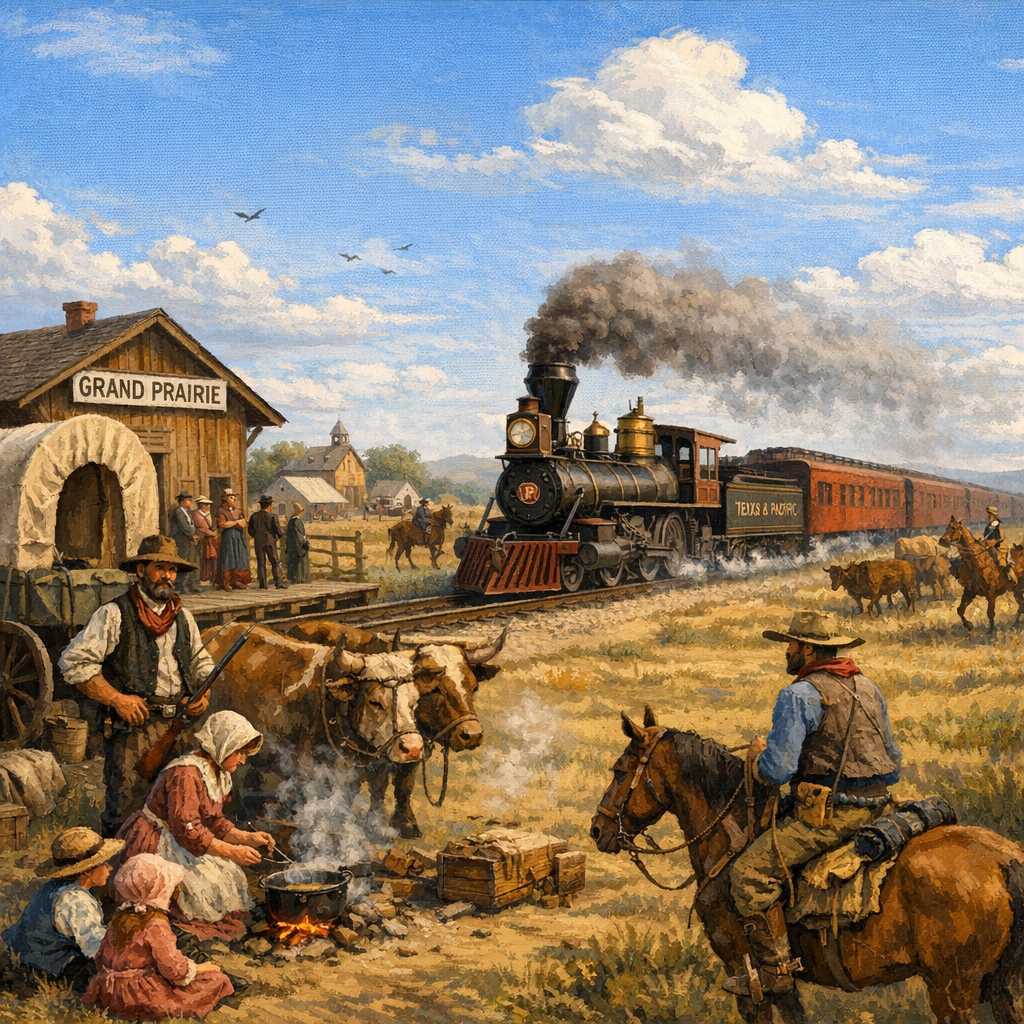
Grand Prairie, Texas, boasts a rich history that reflects the resilience and vision of its early settlers. Understanding our city’s origins offers a deeper appreciation for the community we cherish today.
The Vision of Alexander McRae Dechman
In 1863, Alexander McRae Dechman, a native of Nova Scotia, sought new opportunities in Texas. He acquired land in the area that would become Grand Prairie, trading a broken-down wagon, an ox team, and $200 in Confederate currency for 239.5 acres on the eastern side of the Trinity River and 100 acres of timberland on the west side. Dechman’s initial attempts to establish a home faced challenges, leading him to return to his family in Birdville before joining the Civil War efforts. After the war, he resumed his endeavors to develop the land.
From Dechman to Grand Prairie
Dechman’s commitment to the area’s growth was evident when, in 1876, he traded half of his prairie property to the Texas and Pacific Railroad to ensure the railroad’s passage through the town. The railroad named the depot “Dechman,” prompting him to relocate his home from Bryan to Dechman. However, the establishment of a post office in 1877 introduced a twist: due to a misreading of Dechman’s handwriting, the post office was named “Deckman.” Concurrently, the Texas and Pacific Railroad referred to the area as “Grand Prairie,” based on mid-19th-century maps labeling the region between Dallas and Fort Worth as “the grand prairie of Texas.” To resolve the naming confusion, the post office adopted the name “Grand Prairie,” unifying the community’s identity.
Incorporation and Growth
The town of Grand Prairie was officially incorporated as a city in 1909. Its strategic location between Dallas and Fort Worth facilitated growth, especially with the advent of the aviation industry during World War I. Over the decades, Grand Prairie evolved into a vibrant community, balancing industrial development with a commitment to preserving its unique heritage.
Reflecting on our city’s founding underscores the importance of vision, adaptability, and community spirit. As we navigate the future, honoring our past provides a foundation for continued growth and unity.